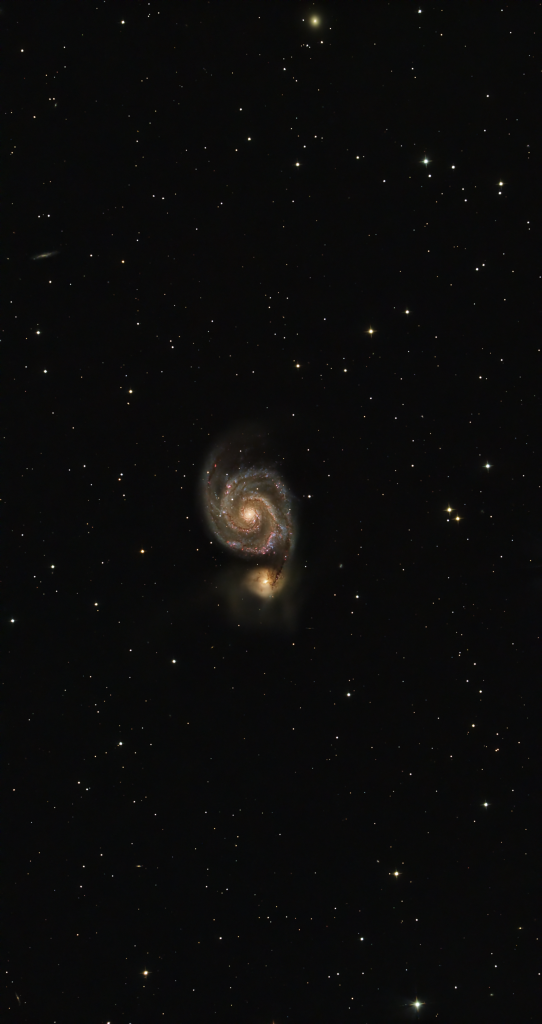
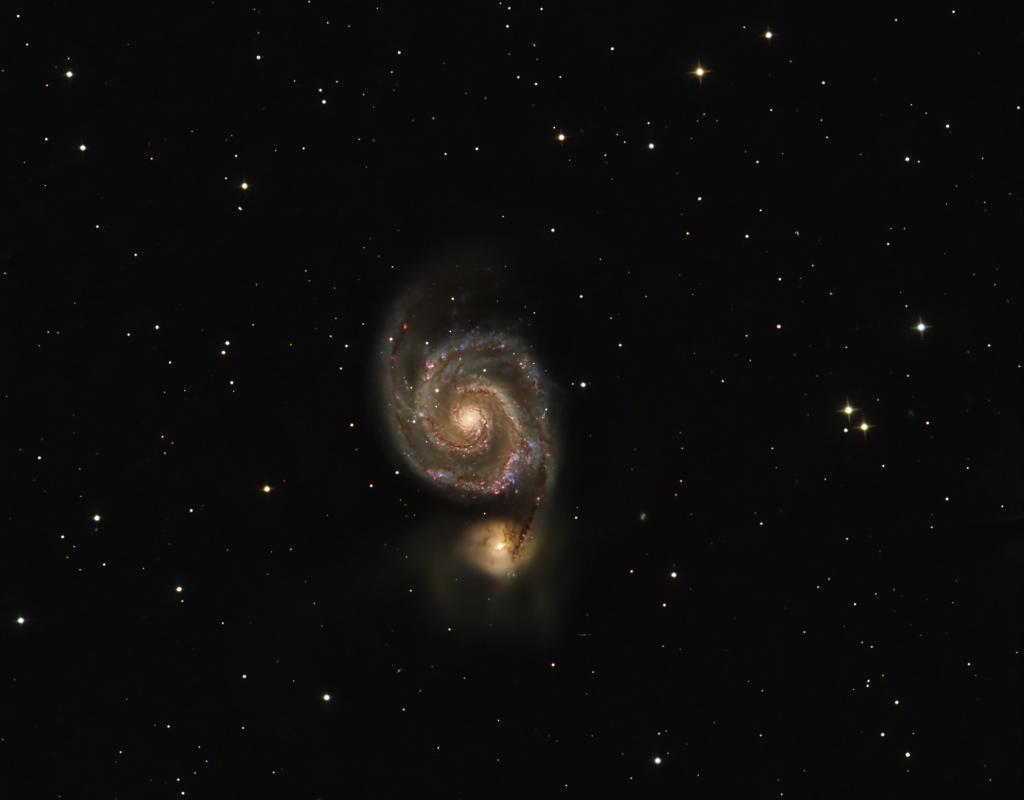
Messier 51: The Whirlpool Galaxy (click for details)
Located approximately 23 million light-years away in the constellation Canes Venatici, Messier 51 (M51)—the Whirlpool Galaxy—is one of the most famous and striking examples of a grand-design spiral galaxy in the night sky.
Key Astronomical Facts
- Classification: SA(s)bc (Grand-design spiral)
- Distance: ~23 million light-years
- Visual Magnitude: 8.4
- Apparent Size: 11.2′×6.9′
Galactic Interaction: M51a and M51b
The most defining feature of M51 is its intense gravitational interaction with its smaller companion, the dwarf lenticular galaxy NGC 5195 (M51b).
As NGC 5195 passed through the main disk of M51 thousands of years ago, its gravitational pull acted like a rock thrown into a pond. This cosmic collision amplified M51’s spiral structure, compressing gas clouds and triggering massive waves of star formation along its prominent dust lanes. This interaction makes it a premier laboratory for studying galactic evolution and tidal forces.
Astrophotography & Observation Notes
M51 is a favorite target for astronomers and astrophotographers alike due to its high inclination (we view it nearly face-on), making its spiral architecture perfectly visible.
- Visual Observation: Under dark skies, a modest telescope will reveal the bright cores of both galaxies. In larger apertures (8″+), the delicate, glowing bridges of the spiral arms begin to emerge.
- Imaging: The galaxy yields incredible detail across various focal lengths. Broad-band LRGB imaging beautifully captures the golden aging stars in the core and the brilliant blue clusters of young stars in the arms.
- H-alpha Enrichment: Supplementing broadband data with H-alpha (Hα) filters reveals vibrant, ruby-red emission nebulae (H II regions) peppered throughout the spiral arms, highlighting active stellar nurseries fueled by the ongoing galactic merger.