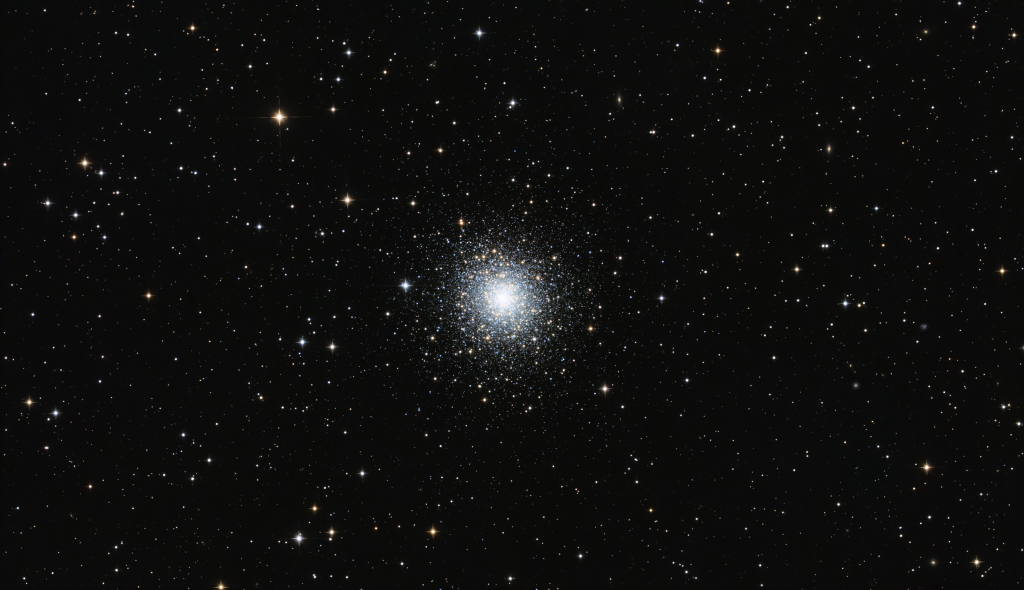
Messier 92: The Hidden Gem of Hercules
Often overshadowed by its famous neighbor M13, Messier 92 (M92) is one of the brightest, oldest, and most spectacular globular clusters in the northern sky. Located roughly 26,700 light-years away in Hercules, M92 is actually more compact and intrinsically brighter than the Great Hercules Cluster, making it a spectacular standalone target.
Key Astronomical Facts
- Classification: Class IV Globular Cluster
- Distance: ~26,700 light-years
- Visual Magnitude: 6.3
- Age: ~14.2 billion years (One of the oldest known objects in the Milky Way)
A Relic from the Dawn of time
M92 is an absolute ancient relic. At an estimated age of over 14 billion years, it formed during the very early stages of the universe, long before our solar system existed.
Because it is a Class IV cluster, its central concentration of stars is significantly denser than M13. Its core is incredibly tightly packed, creating a blazing, high-contrast center that drops off sharply into delicate stellar fringes. Additionally, because it sits nearly 16,000 light-years above the galactic plane, it escaped most of the heavy dust obscuration from the Milky Way’s disk, offering a remarkably clear view.
Astrophotography & Observation Notes
M92 is an exceptional imaging target, particularly for testing the resolving power and tracking accuracy of an imaging rig.
- Visual Observation: Easily visible in binoculars as a bright, fuzzy star. In small telescopes (4 to 6 inches), it resolves beautifully into individual pinpoint stars across its outer halo, though its dense core requires higher magnification to penetrate.
- Imaging Strategy: Because M92 is smaller and tighter than M13 (14.0′ apparent size), it benefits greatly from longer focal lengths to resolve the hyper-dense core. Like all bright globulars, managing the dynamic range is key—combining short exposures (to keep the core from blowing out) with longer exposures (to capture the faint outer halo stars) yields the best results.
- Color Processing: Processing M92 data reveals a beautiful population of aging yellow giants and red giants, interspersed with a scattering of blue stragglers in the core, providing excellent color contrast against the dark background space.