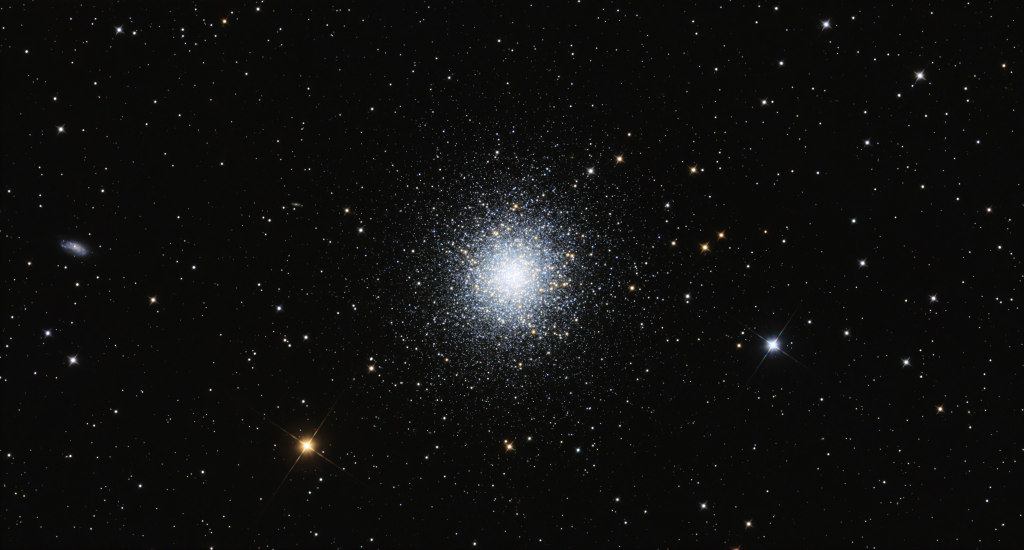
Messier 13: The Great Globular Cluster in Hercules (click for details)
Holding a reputation as the finest globular cluster in the northern celestial hemisphere, Messier 13 (M13) is a breathtaking swarm of several hundred thousand stars. Located roughly 22,200 light-years away in the constellation Hercules, this ancient stellar metropolis is a cornerstone target for visual observers and deep-sky imagers alike.
Key Astronomical Facts
- Classification: Class V Globular Cluster
- Distance: ~22,200 light-years
- Visual Magnitude: 5.8
- Age: ~11.65 billion years
An Ancient Stellar Metropolis
M13 is an incredibly dense, gravitationally bound sphere of stars spanning about 145 light-years across. The stars here are packed so tightly together that near the cluster’s core, they are a fraction of a light-year apart—thousands of times more densely populated than our solar neighborhood.
Because these stars formed early in the universe’s history, M13 is composed of highly evolved, metal-poor stars. It is also famous for hosting “Blue Stragglers”—younger, hotter blue stars that likely formed via stellar collisions or mass transfer in the hyper-crowded core.
The Propeller Feature
A fascinating quirk for high-resolution imagers and keen visual observers is “The Propeller.” This is a distinct, three-bladed dark structure formed by lanes of obscuring dust or a lack of bright stars in the southeastern quadrant of the cluster. Catching this subtle feature is a classic badge of honor for deep-sky enthusiasts.
Astrophotography & Observation Notes
M13 is exceptionally bright, making it a highly accessible and deeply rewarding target.
- Visual Observation: On clear, dark nights, M13 is actually visible to the naked eye as a faint, fuzzy star. A modest telescope easily resolves its outer edges into a sparkling “pile of diamonds,” while larger apertures penetrate deep into the blazing core.
- Imaging Strategy: Because of its high dynamic range, the primary challenge of M13 is preventing the dense core from overexposing (“blowing out”) while still capturing the faint, pinpoint stars on the outskirts. Short, controlled exposures layered into a high-dynamic-range composition work best.
- The Background Galaxy: Wide-field or deep exposures often capture NGC 6207, a small, 12th-magnitude spiral galaxy located just 28′ to the northeast, providing an incredible sense of cosmic depth.