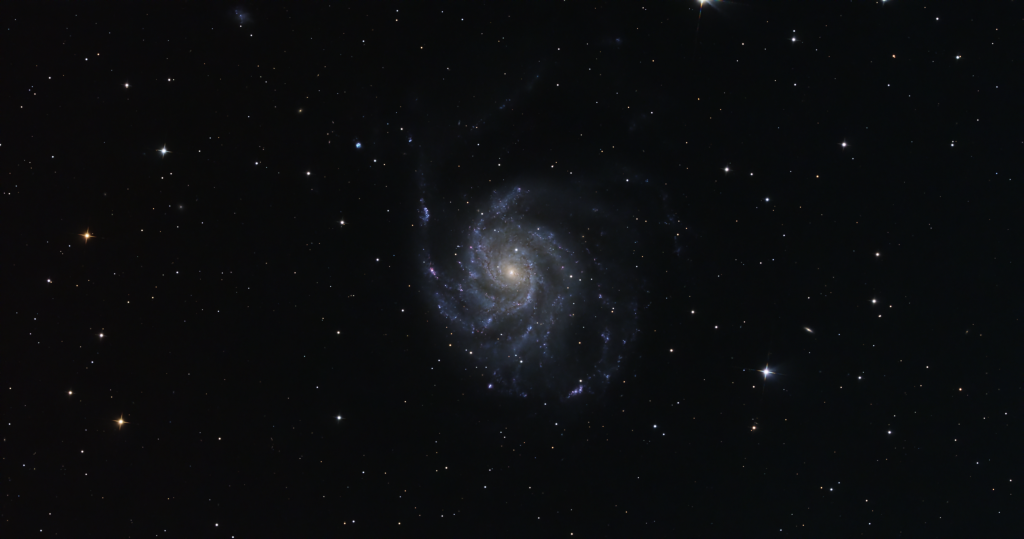
Messier 101: The Pinwheel Galaxy (click for details)
Located approximately 21 million light-years away in the constellation Ursa Major, Messier 101 (M101)—the Pinwheel Galaxy—is one of the most striking and textbook examples of a grand-design spiral galaxy in the night sky.
Key Astronomical Facts
- Classification: SAB(rs)cd (Grand-design spiral)
- Distance: ~21 million light-years
- Visual Magnitude: 7.8
- Apparent Size: 28.8′×26.9′ (Nearly the size of a full moon)
Grand Design and Cosmic Asymmetry
M101 is massive, stretching roughly 170,000 light-years across—nearly twice the diameter of our own Milky Way. Viewed almost perfectly face-on, it features prominent, sweeping spiral arms filled with billions of stars.
However, a closer look reveals that M101 is remarkably asymmetrical. The galactic core is noticeably offset from the geometric center of the disk. This distortion is the result of historical gravitational “tugging” from nearby companion galaxies, which compressed gas clouds on one side and triggered intense starburst activity.
Extreme Starburst Regions (H II)
Because of these tidal interactions, M101 contains an exceptionally high number of massive, ultra-bright H II regions (nebulae of ionized hydrogen gas where new stars are actively forming). Several of these stellar nurseries are so large and luminous that they have earned their own individual NGC designations within the galaxy’s arms, such as NGC 5461 and NGC 5462.
Astrophotography & Observation Notes
M101 is a legendary deep-sky target, but its immense size comes with a notorious catch for astrophotographers and visual observers alike.
- Visual Observation: Despite its bright integrated magnitude, M101 has a very low surface brightness because its light is spread out over a massive area of sky. From light-polluted areas, it can be incredibly difficult to spot. Under pristine, dark skies, large binoculars or small scopes reveal its bright core, while large apertures resolve the faint, mottled structure of its arms.
- Imaging Strategy: M101 demands significant integration time to pull its faint, extensive spiral arms out of the background noise. It frames beautifully across a wide range of focal lengths.
- H-alpha Integration: Integrating Hα data with standard LRGB exposures is highly recommended for this target. The narrow-band data causes the numerous H II star-forming regions to ignite in vibrant pinks and reds, tracing the sweeping architecture of the pinwheel arms perfectly.