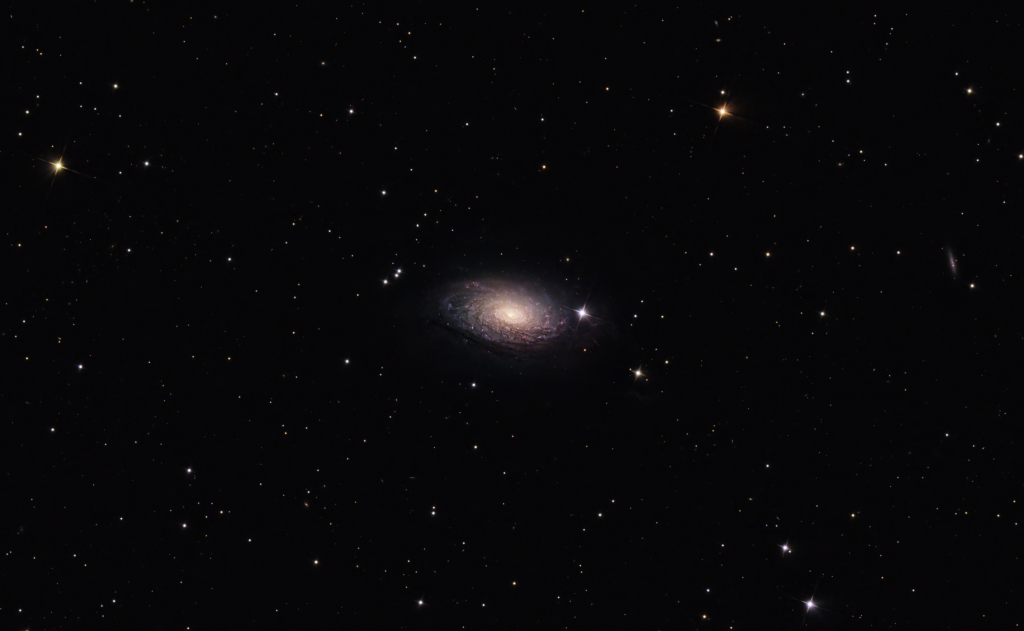
Messier 63: The Sunflower Galaxy (click for details)
Strikingly beautiful and complex, Messier 63 (M63)—popularly known as the Sunflower Galaxy—is a showcase example of a flocculent spiral galaxy. Located approximately 29 million light-years away in the constellation Canes Venatici, its tightly wrapped, segmented spiral arms bear an uncanny resemblance to the pattern of seeds at the center of a sunflower.
Key Astronomical Facts
- Classification: SAbc (Flocculent spiral)
- Distance: ~29 million light-years
- Visual Magnitude: 8.6
- Apparent Size: 12.6′×7.2′
Flocculent Structure vs. Grand Design
Unlike its nearby neighbor M51, which features long, sweeping, continuous spiral arms (grand-design), M63 is a flocculent spiral.
Instead of a few well-defined tracks, M63’s structure consists of a multitude of short, fractured, patchy arm segments that tightly wrap around its exceptionally bright core. This structure is the result of differential galactic rotation shearing apart localized pockets of star formation, rather than a massive density wave passing through the entire disk.
Astrophotography & Observation Notes
M63 is a highly rewarding deep-sky target, offering an intricate tapestry of dark dust lanes and bright stellar nurseries that challenge an imager’s processing skills.
- Visual Observation: Visible in small telescopes as an elongated, bright patch of light with a stellar core. In larger instruments (10″+), the mottled texture of its flocculent disk begins to show, hinting at its complex arm structure under dark skies.
- Imaging: M63 features an extremely high dynamic range. The core is immensely bright and transitions rapidly into a dim, intricate outer disk. Using a luminance layer with excellent contrast control is crucial for resolving the fine, overlapping dust lanes that give the galaxy its unique texture.
- H-alpha Enrichment: The spiral arm segments are peppered with active H II regions. Adding Hα data to your broadband RGB exposures will make these bright stellar nurseries pop with a brilliant pinkish-red hue, mapping out the chaotic pockets of star birth along the cosmic petals of the sunflower.